
Is Spiritual Formation New Age?
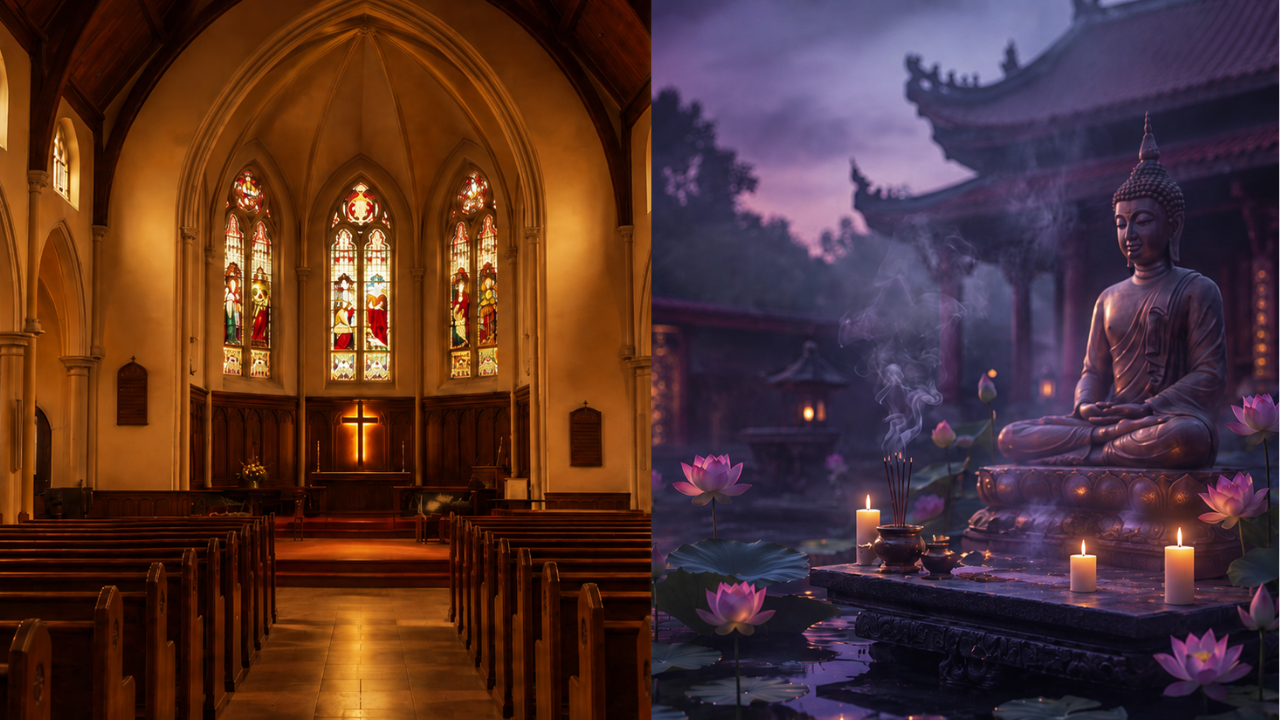
I cannot tell you how many times I’ve taught on spiritual formation—whether in a course or in a sermon—and heard the same objection: “Don’t you know spiritual formation is New Age?” And when I try to explain why it is not, the response is often not a real argument at all. It is usually something dismissive, like, “Well, you’re young. You’re vulnerable. You’re gullible.” The whole thing gets dismissed immediately as “New Age” simply because it involves “introspection”.
Today, we are going to settle this debate.
Hi, I’m Felicity Roelofse. I'm a doctoral candidate at Melbourne School of Theology, where I've spent the last five years researching spiritual formation — and I’m currently a pastor and I've been in ministry for twelve years in two countries.
By the end of this video, you'll know exactly why spiritual formation is not only not New Age, it's deeply biblical.
What is spiritual formation?
So let’s start with the most basic question: what is spiritual formation?
Before I do that, I need to define spiritual theology, of which spiritual formation falls under.
Theology has sub-categories, where theologians can specialize in a specific topic, such as: Christology, pneumatology, eschatology… Spiritual theology, while a newer term than the rest, is simply another sub-category of the overall study of theology.
John Coe, a professor of spiritual theology and philosophy at Biola University’s Institute for Spiritual Formation, who was also my professor, explains that spiritual theology studies (1) the concept of sanctification as described biblically and systematically, and (2) the empirical understanding of the Holy Spirit in the life of the Christian believer.
In other words, spiritual theology asks questions like:
What does it really mean to have a relationship with God?
How does spiritual growth happen?
What helps it? What hinders it?
Spiritual formation is the practice of spiritual theology. Dallas Willard defines spiritual formation as “the process of transformation of the inmost dimension of the human being, the heart, which is the same as the spirit or will.” Spiritual formation thus addresses the holistic development of a person’s spiritual, emotional, and moral life, aiming to align all aspects of the self with God’s will. Willard states that this process will make our inner being of that of Christ himself.
Unlike other evangelical theories on spiritual growth that emphasize biblical study, communal discipleship, or charismatic spiritual gifts for growth, spiritual theologians are typically contemplative, finding meaning in solitude, silence, and spiritual experiences. Typical practices within spiritual formation are Ignatian practices like Lectio Divina, a meditation on Scripture, or the Prayers of Examen, reflecting on the day and finding God in every moment. Paul Bramer, professor of Christian formation and leadership at Tyndale Seminary in Toronto, states that spiritual formation has:
made evangelicals more sensitive to the silence that needs to live between our words, to the discernment that needs to accompany our commitments, to the reflection that needs to undergird our activism, to the lives and voices from the early and medieval church that balance our contemporaneity, and to the universal and communal nature of the church that heals our atomization. Our ways of reading the Bible, praying, nurturing younger Christians, reimagining sabbath, accessing the classics of the faith, engaging in issues of compassion, justice, and sustainability, and worshipping are all being broadened and deepened.
Evan B. Howard similarly describes spiritual formation as “the intentional and semi-intentional processes by which believers (individuals and communities) become more fully conformed and united to Christ, especially with regard to maturity of life and calling.” M. Robert Mulholland Jr. similarly defines spiritual formation and its goal as:
A process of being formed in the image of Christ, a journey into becoming persons of compassion, persons who forgive, persons who care deeply for others and the world, persons who offer themselves to God to become agents of divine grace in the lives of others and their world—in brief, persons who love and serve as Jesus did.
Where does the New Age concern come from?
Now once you define spiritual formation that way, the obvious question is: if this is such a normal part of Christian discipleship, why do so many Christians hear the term and immediately panic?
The New Age concern around spiritual formation largely arose when many evangelicals first encountered the modern spiritual formation movement through writers such as Richard Foster and, later, Renovaré. What had once seemed unfamiliar to many Protestants—silence, solitude, meditation, and contemplation—suddenly became prominent, and some early critics even denounced the movement as “New Age Heresy.”
A major flashpoint was contemplative prayer. Critics argued that certain forms of it sounded less like biblical meditation on God’s Word and more like methods associated with Eastern religion or New Age spirituality. John Coe summarizes the controversy clearly: for many critics of the spiritual formation movement, contemplative prayer was seen as foreign to Scripture and “more akin to New Age and eastern religions.”
The concern was also strengthened by the fact that some contemplative institutions openly described themselves as drawing wisdom from beyond the Christian tradition. Shalem, for example, says it is grounded in Christian contemplative spirituality while also drawing on “the wisdom of many religious traditions.” In a separate Shalem piece on Thomas Keating and Centering Prayer, the practice is described as having taken shape in the 1970s partly in response to young Christians seeking a meditative path and asking directions to a nearby Buddhist meditation center. That does not prove spiritual formation is New Age, but it helps explain why some evangelicals became suspicious.
At a deeper level, the objection also reflects a distinctly Protestant fear that spiritual formation can drift away from Scripture, grace, repentance, and sanctification and become absorbed with techniques, inner states, or spiritual self-cultivation. Even sympathetic voices within the movement warned against exactly that kind of distortion.⁵ Meanwhile, older evangelical scholarship also argued that it is a mistake to dismiss all spirituality as New Age, since evangelicals have their own rich devotional heritage and should recover it with discernment rather than suspicion.
So the concern comes from both overreaction and real boundary anxiety. It is overreaction when all contemplative practice is dismissed as New Age without distinction. But it reflects a genuine concern when spiritual formation is presented in ways that seem detached from biblical revelation, explicitly Christ-centered prayer, and historic Christian theology.
What is New Age
So before we can say what spiritual formation is not, we need to define What is New Age?
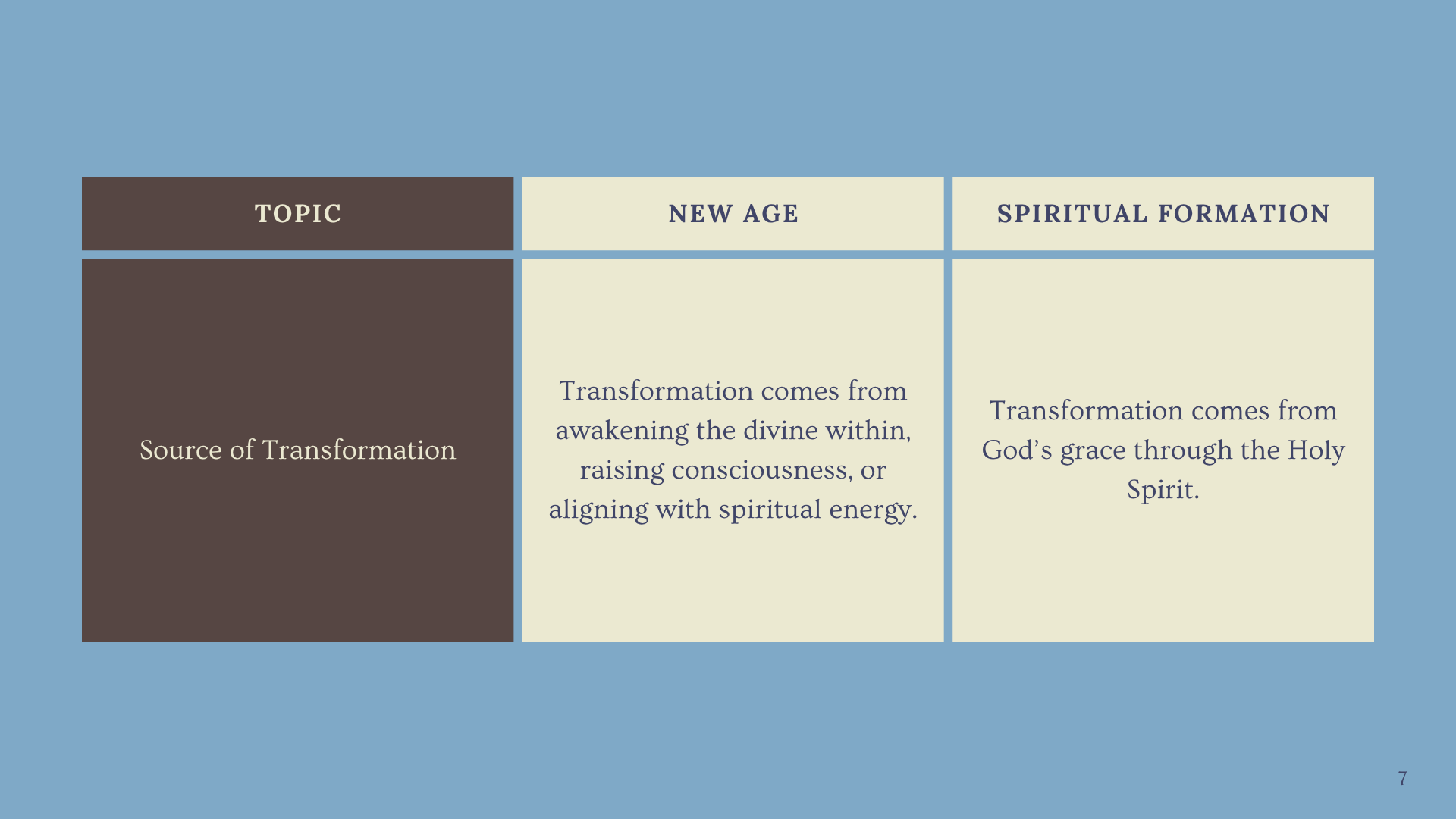
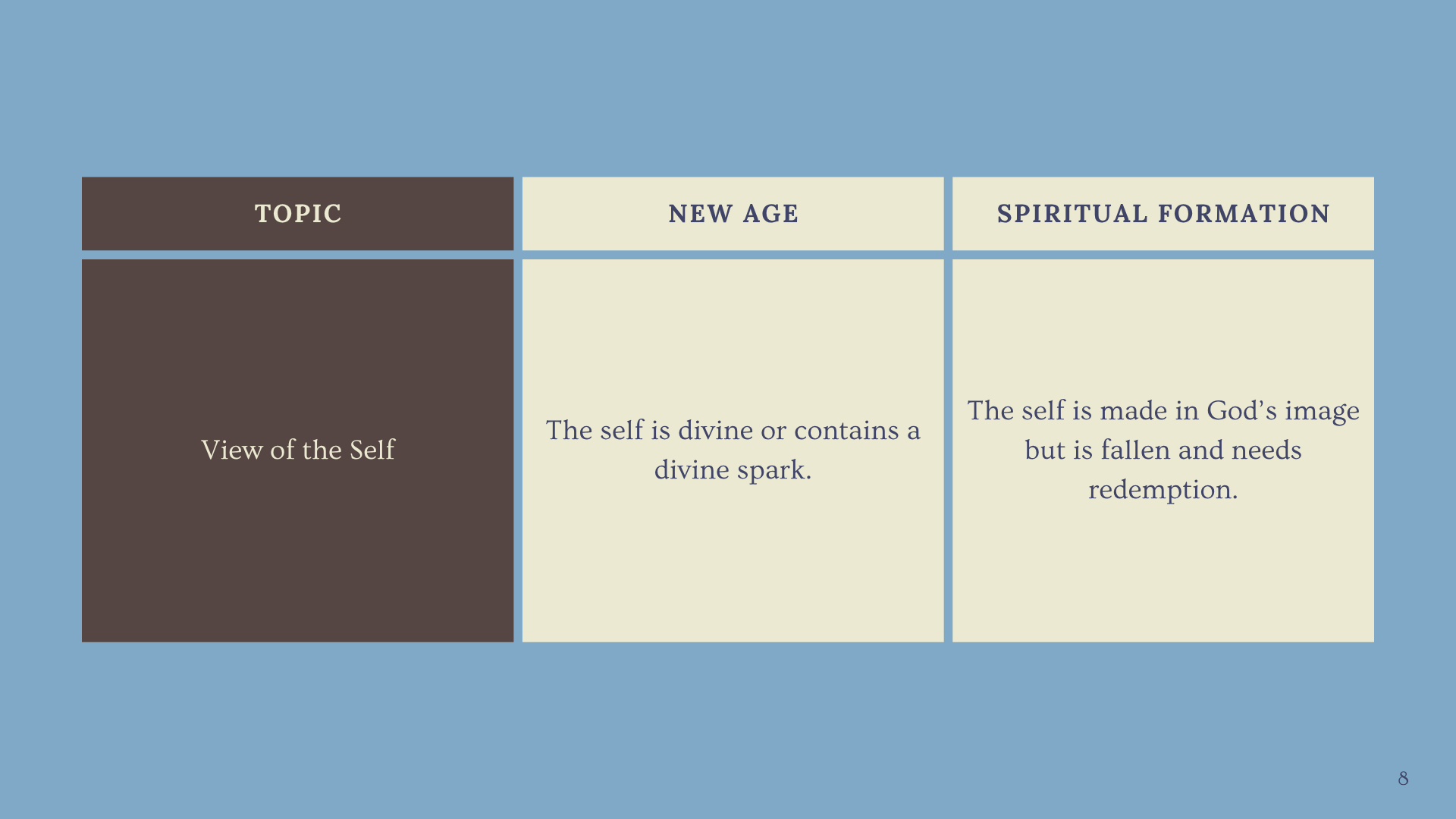
At its core, New Age spirituality tends to assume that the divine is within us, or that God is diffused through everything in an impersonal way. The goal becomes awakening to the divine within, accessing spiritual power, or opening oneself to a universal spiritual reality. It often emphasizes self-actualization, experiential awakening, holistic living, and openness to many different traditions at once.
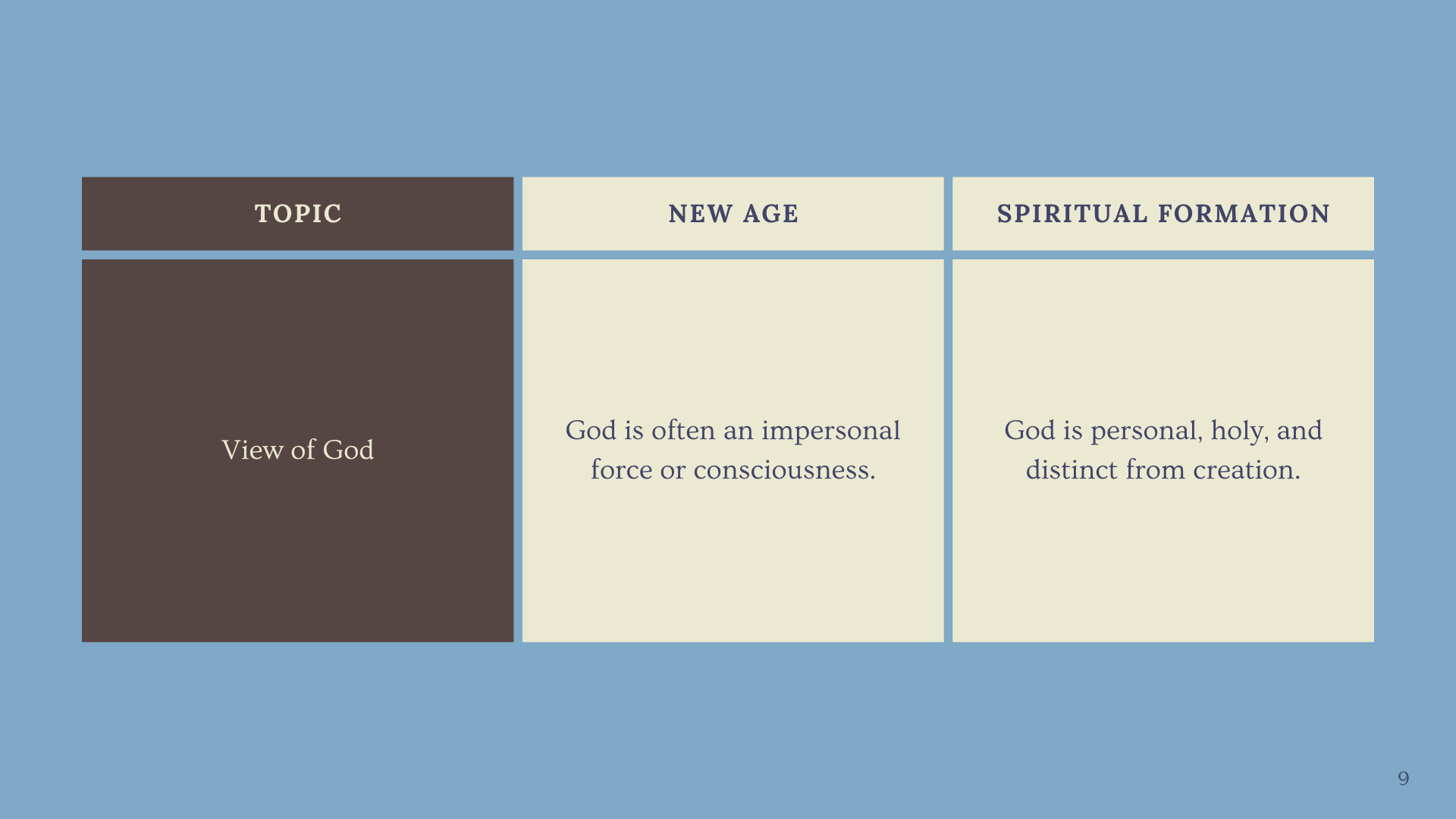
That is one of the key differences between New Age spirituality and Christian spirituality. In Christianity, we do not believe that we are divine. We do not awaken ourselves into godhood. We do not discover truth by moving inward until we find some hidden divine essence in ourselves. We receive revelation from the God who is distinct from us, who has spoken, who has acted in history, and who makes himself known supremely in Christ.
New Age systems also tend to blend together pieces from many different religious traditions, even if those traditions contradict each other. And very often, they use spiritual language to avoid dealing honestly with pain, sin, trauma, or emotional struggle. That is one reason spiritual bypassing can become such a problem: spirituality becomes a way to avoid reality instead of face it.
So yes, Christians should be cautious. But notice what we are being cautious about. We are not being cautious about prayer, holiness, silence, repentance, or attentiveness to God. We are being cautious about worldviews that deny biblical revelation, flatten the distinction between Creator and creature, and place spiritual power in the autonomous self.
That is not what Christian spiritual formation is doing.
Here is a clear comparison table using broad New Age beliefs and historic Christian theology:
So, why the controversy?
From a pastoral perspective, my sense is that people who immediately rebuke spiritual formation usually fall into a few categories.
First, many of them simply are not paying close attention to what is actually being taught. They hear words like introspection or silence and instantly assume something unbiblical or even demonic is going on. But that reaction does not hold up. Scripture is full of self-examination, repentance, reflection, and asking God to search our hearts. You cannot grow into the heart of God while refusing to honestly face what is going on inside you. And you cannot truly know yourself apart from the Holy Spirit’s guidance.
Second, I think some people are actually afraid of being fully known by God. So instead of going deeper with the Lord in prayer, they dismiss spiritual formation as “New Age” and use that label as an excuse to stay spiritually shallow. That may sound harsh, but I think in some cases it is true. There can be real spiritual resistance to surrender, honesty, and deeper communion with God.
Third, some people seem to have had a negative encounter with someone who used spiritual language in a vague or slightly New Age way, and now they assume that everyone talking about spiritual formation is doing the same thing. But that is not a fair conclusion.
So again, from my perspective as a pastor, I do think many of these naysayers have spiritual roadblocks in the way. Because honestly, what is the harm in asking God to show you what is going on inside your heart? What is the harm in wanting to go deeper in your relationship with Him? Why is the desire for greater intimacy with God automatically treated as suspicious?
Conclusion
In my next video, I’m going to be answering the question: "Is Contemplative Prayer Dangerous? What the Bible Actually Says." I find that within the anti-spiritual formation movement, they try to argue that contemplative prayer is dangerous and unbiblical, which I will dispute both biblically and theologically. In forthcoming videos, I’ll also address the issues around Dallas Willard, Richard Foster, and John Mark Comer. So if you’re interested in those topics, definitely subscribe.
If you want to go deeper on this — the practices, the theology, the history — head over to my website and sign up for my email list. That's where I share more than I can fit into a video.
And if you found this video helpful, please like and subscribe. I'm committed to making content that actually equips you — not just content that is just more Christian-ese or empty platitudes that we so often hear. So stick around. There's a lot more to come.
—-
Bramer, Paul D. G. “Guest Editorial: Introduction to the Special Focus: Spiritual Formation and Christian Education.” Christian Education Journal 7, no. 2 (2010): 334–39.
Calhoun, Adele Ahlberg. Spiritual Disciplines Handbook: Practices That Transform Us. Downers Grove, IL: InterVarsity Press, 2005.
Coe, John H. “The Controversy over Contemplation and Contemplative Prayer: A Historical, Theological, and Biblical Resolution.” Journal of Spiritual Formation & Soul Care 7, no. 1 (2014): 140–53.
Coe, John H. “Spiritual Theology: A Theological-Experiential Methodology for Bridging the Sanctification Gap.” Journal of Spiritual Formation & Soul Care 2, no. 1 (2009): 4–43.
Hingley, C. J. H. “Evangelicals and Spirituality.” Themelios 15, no. 3 (April–May 1990): 86–91.
Howard, Evan B. The Brazos Introduction to Christian Spirituality. Grand Rapids, MI: Brazos Press, 2008.
Mulholland, M. Robert Jr. Invitation to a Journey: A Road Map for Spiritual Formation. Revised and expanded ed. Downers Grove, IL: InterVarsity Press, 2016.
Shalem Institute for Spiritual Formation. “About Shalem.” Accessed April 6, 2026. https://shalem.org/about/.
Smith, James Bryan. “Dallas Willard’s 3 Fears About the Spiritual Formation Movement.” Christianity Today, August 2022. https://www.christianitytoday.com/2022/08/dallas-willard-fears-spiritual-formation-movement/.
van Balen, Mary. “Thomas Keating and Centering Prayer.” Shalem Institute for Spiritual Formation, November 9, 2018. https://shalem.org/2018/11/09/thomas-keating-and-centering-prayer/.
Willard, Dallas. Renovation of the Heart: Putting on the Character of Christ. Colorado Springs, CO: NavPress, 2002.
