
Rooted in faith.
I’m Dr. Felicity Roelofse — theologian and pastor. I bring together both biblical scholarship and real ministry experience, in order to help you understand what it truly means to go deeper with God.
Alongside my academic work, I have served in ministry for over a decade across churches, teaching contexts, and pastoral settings in both the United States and Australia.
Thoughtful theology for the inner life.

Bible Studies for Real Life
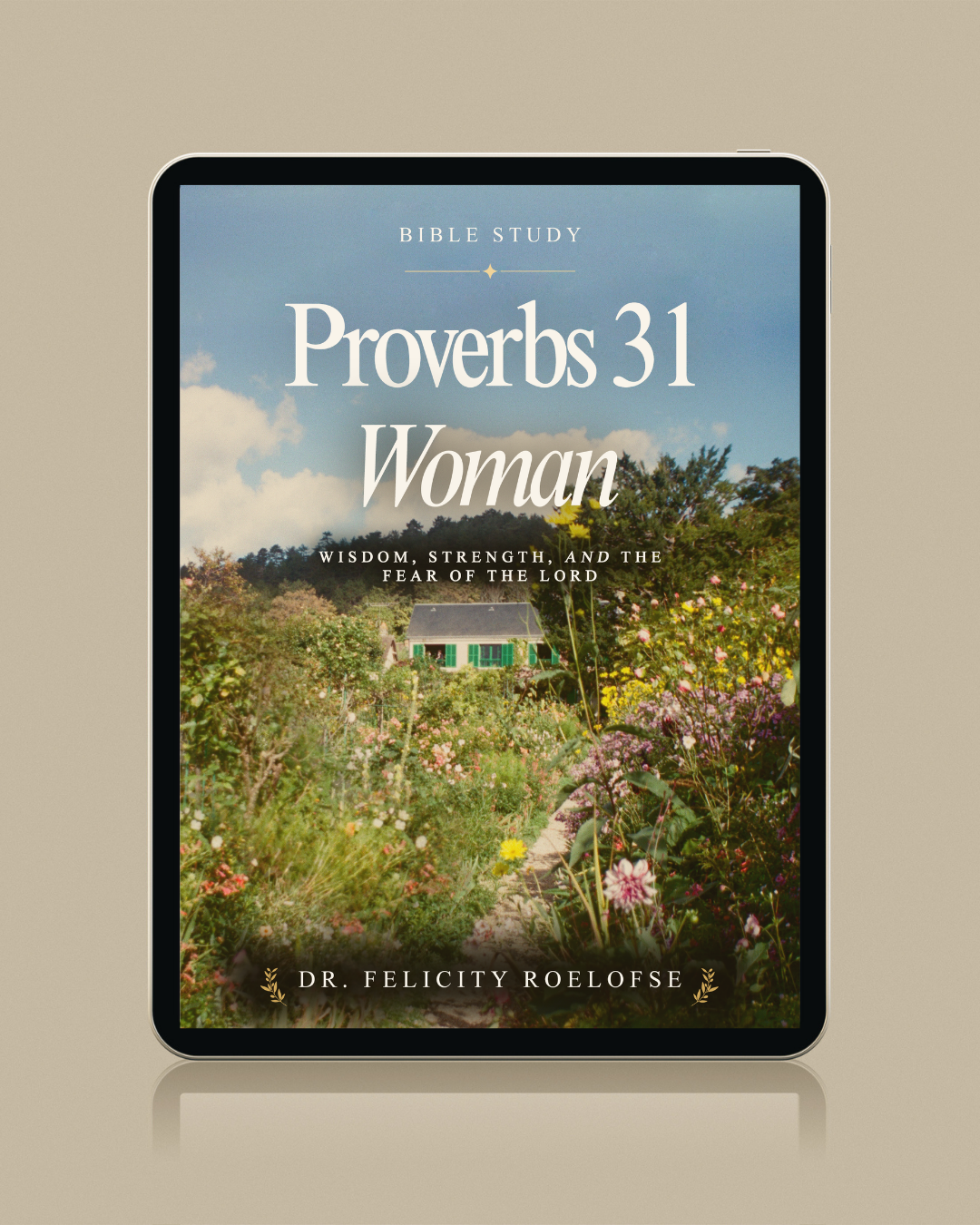
One time, I was having a coffee with a buddy of mine, and I mentioned something about Proverbs 31. He rolled his eyes, “Oh yeah, the Proverbs 31 woman.” He then smirked at the ridiculous notion.
This passage has an interesting reputation. In my ministry experience, some women love to study Proverbs 31, and some find it distasteful as it conjures up images of women’s ministries with flower bouquets, crafting, tupperware parties. For some women, Proverbs 31 represents marriage and children — something they cannot or do not want to have.
Yet, as both a woman and academic, I appreciate this passage so much because it emphasizes that women can be profitable, skilled, and independent. So often in the Christian community, we emphasize the woman’s submissive role. Yet here in Proverbs 31, we see an image of a woman who seems to be able to do it all! God offers so many interesting descriptions of womanhood in the Bible, and I find this particular passage the most empowering.
We’ll dive deep together into this important passage, showing that no matter what kind of woman you are, you can grow in self-confidence in your abilities, family, and relationship with God.
When I originally wrote this study, it was the era of the GIRLBOSS. Well, that went out of style, and it’s not my vibe anyway. I rewrote this study with more emphasis on who the Lord made you to be as a woman. As I was writing it, I often thought, “How can I make this relatable to all women?” I really tried to keep this in mind, rather than the traditional teaching on Proverbs 31 to just married women, or women who like pink. Or women who like flowers. We each have a unique role in our lives, work, relationships. We are not all the same! And that is wonderous to God. So, I hope you take away from this study that the Lord wants you to be uniquely you.
This is a 4 week study. You can complete it in 4 weeks or however long you want. Savour it, rush it. It’s yours to decide.
After leaving Bible college, I became increasingly frustrated by sermons I would hear. These pastors seemed to take one verse and then create an entire theology around that verse, rather than looking at its context. What’s more, they would create 3 arbitrary applications and spend all of their time on that. Where’s the biblical Hebrew? The Greek? The Jewish culture? The topography? The historical context?!
Well, I realized — why not just write an easy guide on how to do this? Maybe not everyone knows how to look for those things. So that’s why I wrote this. I’ve taken everything I’ve learned across my degrees into an easy guide for you, so you can read the Bible like a scholar. Context is so important to a passage — it ensures we understand the author’s intent, sees a passage within the scope it was written, and recognizes how the time period, geography, or political climate all impact the passage. It also helps you respond to arguments of, “Well, that was contextual to the time.” How do you know that? Well, now you’ll know how to determine if a passage was purely contextual or still relevant to today.
My hope is that after reading this guide, you’ll develop some new tools in your Bible study time. Look, I’m not expecting you to spend hours on a passage as if you were writing a thesis. But, I do want to equip you with hermeneutics, exegesis, and lower and higher textual criticism (you’ll learn what these mean in the guide). Note that this is a guide, not a book, so it should be easy reading. And hey, it’s free! I want to equip more people with these tools that I got to learn in university.
Latest on My Youtube
Encouragement Straight to Your Inbox